The Harmonic Minor is a dark, dramatic minor sound with a strong pull back to the tonic. Compared to natural minor, it has one crucial change: the 7th degree is raised.
That raised 7th gives the scale its intense, almost classical or cinematic flavor. On guitar, it often sounds:
- Dark and emotional
- Exotic without being too “outside”
- Neoclassical and dramatic
- Perfect for metal, progressive rock, fusion, and soundtrack-style writing
Technically, harmonic minor is usually called a scale rather than a “mode” in the same way Dorian or Phrygian are modes of the major scale. But guitarists often talk about “the harmonic minor mode” when they mean the core harmonic minor sound.
How does it sound?
Before anything else, let’s hear how it sounds. This can best be done by playing a chord from the mode, and playing the notes of the mode arpeggiated on top of it. This is the best and quickest way to determine the feel of a mode.
This can be quickly done using SLModes, a software dedicated to the music modes, and the following sound was generated by it:
Formula
The interval formula for harmonic minor is:
1 2 b3 4 5 b6 7
Compared to natural minor:
Natural minor: 1 2 b3 4 5 b6 b7 Harmonic minor: 1 2 b3 4 5 b6 7
The raised 7th is the defining note.
In C, that means Bb becomes B natural.
Notes in C
The notes of C Harmonic Minor are:
C D Eb F G Ab B
Scale degrees:
- C = 1
- D = 2
- Eb = b3
- F = 4
- G = 5
- Ab = b6
- B = 7
The most important color tones are:
- Eb — gives the scale its minor quality
- Ab — adds darkness and tension
- B — creates the strong leading-tone pull back to C
That Ab to B gap is an augmented second. It is one of the reasons harmonic minor sounds so distinctive.
The Chord That Defines the Mode
The chord that best captures the sound of C Harmonic Minor is:
Cm(maj7)
Spelled:
C Eb G B
This chord contains:
- C — root
- Eb — minor 3rd
- G — perfect 5th
- B — major 7th
The combination of a minor triad with a major 7th is the signature harmonic minor sound. It feels dark, tense, elegant, and unresolved.
A regular Cm7 chord uses Bb:
C Eb G Bb
That sounds more like natural minor, Dorian, or Aeolian.
But Cm(maj7) uses B natural:
C Eb G B
That B natural immediately tells your ear, “This is harmonic minor.”
Another important chord is G7, the V7 chord in C minor:
G B D F
The B natural inside G7 pulls strongly back to C. This is why harmonic minor is so important in classical music, metal, jazz, and cinematic harmony.
Still, if you want one chord that screams “C Harmonic Minor,” use:
Cm(maj7)
Chord Progression (Example)
Here is a practical C Harmonic Minor progression for guitarists, songwriters, and producers.
Roman numerals:
i – iv – V7 – i
Chords in C:
Cm – Fm – G7 – Cm
This is the classic harmonic minor sound.
The G7 chord contains B natural, which creates a strong pull back to Cm. This is one of the main reasons harmonic minor exists: it gives minor-key music a dominant V chord with real resolution.
Mood:
- Dramatic
- Classical
- Tense but familiar
- Great for metal riffs, ballads, and cinematic sections
Try palm-muting the roots and letting the G7 ring before resolving to Cm.
Famous Songs and Guitarists Using Harmonic Minor
Harmonic minor is widely used in guitar music, but it is important to be accurate: many songs do not stay strictly in harmonic minor from beginning to end.
Instead, guitarists often use harmonic minor:
- Over a minor tonic chord
- Over a V7 resolving to minor
- In neoclassical lead lines
- In metal riffs and classical-inspired sequences
Guitarists and artists commonly associated with harmonic minor sounds include:
- Yngwie Malmsteen — especially in neoclassical metal pieces like “Far Beyond the Sun” and “Black Star”
- Ritchie Blackmore — Rainbow and Deep Purple often use classical minor-key vocabulary associated with harmonic minor
- Randy Rhoads — commonly associated with classical-influenced minor sounds, especially in solos and darker progressions
- Jason Becker and Marty Friedman — both use harmonic minor and related exotic minor sounds in shred and fusion-metal contexts
- John Petrucci / Dream Theater — harmonic minor appears as part of the progressive metal vocabulary, especially in dramatic minor-key sections
Outside guitar music, harmonic minor is extremely common in:
- Classical music
- Film scores
- Flamenco-influenced harmony
- Metal
- Jazz minor-key harmony
Guitar Fretboard Shape
Here’s the mode mapped across the full fretboard, generated with my software SLModes.
The diagram shows every occurrence of the mode across the neck:
🟢 Green dots = the root note, your anchor points
🟠 Orange dots = the rest of the scale tones

Why Guitarists Love This Mode
C Harmonic Minor gives you a darker sound than the major modes, but it has more tension and direction than natural minor.
Natural minor can sound moody and open-ended.
Harmonic minor sounds like it wants to resolve.
That makes it perfect for:
- Dark melodies
- Dramatic solos
- Neoclassical runs
- Emotional chord progressions
- Film-score-style guitar parts
The raised 7th gives your phrases a strong destination.
Genres Where It Works Well
C Harmonic Minor is useful in many guitar-heavy styles:
- Progressive metal
- Neoclassical metal
- Fusion
- Hard rock
- Symphonic metal
- Dark pop
- Film-score-inspired rock
- Jazz minor harmony
- Flamenco-influenced guitar
It is especially powerful when you want a sound that is minor, dramatic, and harmonically focused.
Tips for Practicing
To practice a mode effectively, you only need two things:
- An instrument to play the mode (your guitar is ready to go!)
- A backing track that provides a harmonic context
The fretboard diagram above already show you where the notes are. The remaining piece is choosing an appropriate backing track to improvise over.
Practice with a drone
The simplest option is a single C drone.
You can create one using:
- A looper pedal
- A synth drone
- A sustained bass note in your DAW
- An open C tuning
- Or any other source of a continuous C note
Because the accompaniment consists of only a single note, you are responsible for highlighting the intervals that define the mode. The more intentionally you emphasize its characteristic tones, the more clearly the modal sound will emerge.
Create modal vamps with SLModes
While a drone is an excellent way to hear a mode in isolation, a modal vamp often provides a more musical and rewarding practice experience.
A well-designed backing track naturally emphasizes the mode’s characteristic intervals, allowing you to focus on phrasing, melody, and expression instead of constantly trying to establish the modal sound yourself. As a result, improvising in the character of the mode often feels more intuitive.
There are many ways to build modal backing tracks, but SLModes can generate them for you in just a few clicks. For example:
- Arpeggiated backing tracks — a repeating pattern that outlines every note of the mode.
- Chord vamps — progressions built from chords that best reinforce the mode’s unique character.
This video shows you an example:
If you like modes, SLModes is for you
SLModes is the software for exploring everything related to music modes.
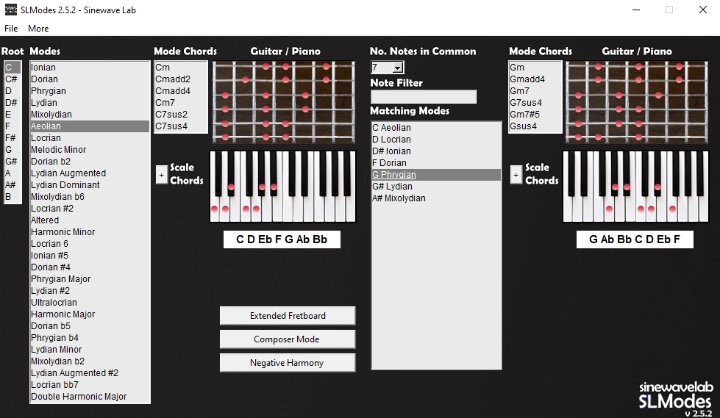
It helps you experiment with:
- Modal chords
- Guitar fretboard shapes
- Chord progressions
- Modal modulation
- Negative harmony ideas
If you play guitar and want to access 60+ music modes, SLModes is waiting for you
Join the Newsletter
Interested in music theory like this? Leave your email below and I’ll keep you updated.