Ionian ♯2 is a bright major mode with a strange, futuristic twist.
At first, it feels close to the regular major scale because it has a major 3rd, perfect 5th, major 6th, and major 7th. But the raised 2nd gives it a sharp, exotic color that immediately separates it from normal Ionian.
Instead of the smooth sound of:
C D E F G A BC Ionian ♯2 gives you:
C D# E F G A BThat D# creates a tense half-step pull into E, the major 3rd. The result is a mode that sounds:
- Major, but unstable
- Bright, but mysterious
- Exotic, synthetic, and slightly “wrong” in a cool way
- Great for fusion, progressive rock/metal, film-style harmony, and experimental songwriting
Think of it as a major scale that has been bent toward something more dramatic and surreal.
How does it sound?
Before anything else, let’s hear how it sounds. This can best be done by playing a chord from the mode, and playing the notes of the mode arpeggiated on top of it. This is the best and quickest way to determine the feel of a mode.
This can be quickly done using SLModes, a software dedicated to the music modes, and the following sound was generated by it:
Formula
The interval formula for Ionian ♯2 is:
1 ♯2 3 4 5 6 7In interval names:
P1 A2 M3 P4 P5 M6 M7Compared to regular Ionian, only one note changes:
Ionian:     1  2  3  4  5  6  7
Ionian ♯2:  1 ♯2  3  4  5  6  7
That one altered note makes a huge difference.
Notes in C
C Ionian ♯2 contains the notes:
C D# E F G A BIt is important to spell the second note as D#, not Eb.
Why?
Because this mode has both D# and E. The D# functions as a raised 2nd, or #9, leading into the major 3rd, E.
If you call it Eb, it starts to look like a minor 3rd, which misrepresents the sound of the mode. C Ionian ♯2 is still fundamentally a major mode.
The Chord That Defines the Mode
The chord that best captures the sound of C Ionian ♯2 is:
Cmaj7(#9)Chord tones:
C E G B D#This chord works because it includes the stable major sound of Cmaj7:
C E G BBut it also adds the signature note:
D# = #9That #9 is the emotional center of the mode. It creates a spicy clash against the major 3rd, E, while still keeping the overall harmony bright and major.
A useful guitar voicing:
Cmaj7(#9)

E|--x--
B|--4--  D#
G|--4--  B
D|--2--  E
A|--3--  C
E|--x--
Or a wider, more modern voicing:
Cmaj7(#9)

E|--11-- D#
B|--8--- G
G|--9--- E
D|--9--- B
A|--x---
E|--8--- C
This is not a soft, traditional major chord. It has bite. It sounds modern, tense, and cinematic.
Chord Progression (Example)
Because Ionian ♯2 is an advanced synthetic mode, not every diatonic chord sounds equally familiar. The strongest progressions are usually built around the tonic chord and the mode’s most colorful available chords.
Imaj7(#9) - IVmaj7 - V7#5 - Imaj7(#9)In C:
Cmaj7(#9) - Fmaj7 - G7#5 - Cmaj7(#9)This progression has a bright but dramatic sound.
The Fmaj7 gives a smooth, open release. The G7#5 adds tension because the note D# functions as the augmented 5th of G. When it resolves back to Cmaj7(#9), the progression feels familiar and strange at the same time.
Mood:
- Cinematic
- Progressive
- Bright but uneasy
- Great for clean arpeggios or layered guitar parts
Guitar Fretboard Shape
Here’s the mode mapped across the full fretboard, generated with my software SLModes.
The diagram shows every occurrence of the mode across the neck:
🟢 Green dots = the root note, your anchor points
🟠 Orange dots = the rest of the scale tones

Why Guitarists Love This Mode
C Ionian ♯2 is exciting because it gives you a major sound that does not feel predictable.
The mode has a bright center, but the ♯2 adds tension immediately.
That gives you a sound that can feel:
- Futuristic
- Exotic
- Unstable
- Heroic but strange
- Beautiful in an uneasy way
It works especially well when you want something major, but not cheerful or ordinary.
Genres Where It Works Well
C Ionian ♯2 can fit into:
- Progressive rock
- Progressive metal
- Jazz fusion
- Modern instrumental guitar
- Film and game music
- Experimental songwriting
- Ambient guitar music
- Math rock and post-rock textures
It is especially powerful when layered with clean chords, synth pads, or heavy low-string pedal riffs.
Tips for Practicing
To practice a mode effectively, you only need two things:
- An instrument to play the mode (your guitar is ready to go!)
- A backing track that provides a harmonic context
The fretboard diagram above already show you where the notes are. The remaining piece is choosing an appropriate backing track to improvise over.
Practice with a drone
The simplest option is a single C drone.
You can create one using:
- A looper pedal
- A synth drone
- A sustained bass note in your DAW
- An open C tuning
- Or any other source of a continuous C note
Because the accompaniment consists of only a single note, you are responsible for highlighting the intervals that define the mode. The more intentionally you emphasize its characteristic tones, the more clearly the modal sound will emerge.
Create modal vamps with SLModes
While a drone is an excellent way to hear a mode in isolation, a modal vamp often provides a more musical and rewarding practice experience.
A well-designed backing track naturally emphasizes the mode’s characteristic intervals, allowing you to focus on phrasing, melody, and expression instead of constantly trying to establish the modal sound yourself. As a result, improvising in the character of the mode often feels more intuitive.
There are many ways to build modal backing tracks, but SLModes can generate them for you in just a few clicks. For example:
- Arpeggiated backing tracks — a repeating pattern that outlines every note of the mode.
- Chord vamps — progressions built from chords that best reinforce the mode’s unique character.
This video shows you an example:
If you like modes, SLModes is for you
SLModes is the software for exploring everything related to music modes.
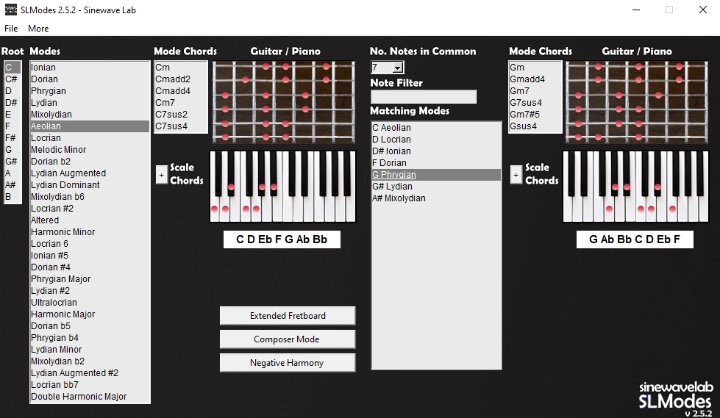
It helps you experiment with:
- Modal chords
- Guitar fretboard shapes
- Chord progressions
- Modal modulation
- Negative harmony ideas
If you play guitar and want to access 60+ music modes, SLModes is waiting for you
Join the Newsletter
Interested in music theory like this? Leave your email below and I’ll keep you updated.