Mixolydian ♭6 is a dark, exotic-sounding dominant mode.
It has the bluesy, rock-friendly pull of Mixolydian because it contains a major 3rd and a minor 7th. But the flattened 6th gives it a more dramatic, mysterious, and slightly “Eastern” or cinematic color.
If regular Mixolydian sounds like classic rock, blues-rock, or funk, Mixolydian ♭6 sounds more tense, smoky, and progressive.
For guitarists, this mode works especially well over dominant chords with a darker flavor, such as 7♭13, 9♭13, or modal vamps based around 7.
It is also known as the 5th mode of melodic minor.
How does it sound?
Before anything else, let’s hear how it sounds. This can best be done by playing a chord from the mode, and playing the notes of the mode arpeggiated on top of it. This is the best and quickest way to determine the feel of a mode.
This can be quickly done using SLModes, a software dedicated to the music modes, and the following sound was generated by it:
Formula
The interval formula for Mixolydian ♭6 is:
1 2 3 4 5 ♭6 ♭7
In C:
- 1 = C
- 2 = D
- 3 = E
- 4 = F
- 5 = G
- ♭6 = Ab
- ♭7 = Bb
Compared to regular C Mixolydian:
C Mixolydian: C D E F G A Bb C Mixolydian ♭6: C D E F G Ab Bb
The only difference is the ♭6.
That one note changes the mood dramatically.
Notes in C
The notes of C Mixolydian ♭6 are:
C D E F G Ab Bb
On guitar, think of it as:
- C major sound from the root to the 5th
- Dark minor color from the ♭6 and ♭7
- Dominant chord energy from the 3rd and ♭7
The most important color tones are:
- E — the major 3rd
- Bb — the minor 7th
- Ab — the ♭6 / ♭13
Those three notes define the sound very clearly.
The Chord That Defines the Mode
The defining chord of C Mixolydian ♭6 is:
C7♭13
Notes:
C E G Bb Ab
This chord captures the mode because it contains the basic dominant 7th structure:
C E G Bb
And then adds the special color note:
Ab = ♭13
That ♭13 is the note that separates this mode from regular Mixolydian.
A regular C7 chord can sound bluesy, funky, or classic rock. But once you add the Ab, the chord becomes darker and more tense.
You can also use:
- C9♭13 — C E G Bb D Ab
- C7(add♭13) — C E G Bb Ab
- C13♭9? Be careful: C Mixolydian ♭6 does not contain Db, so it is not naturally a ♭9 sound.
The safest chord symbol is:
C7♭13
That is the home base.
Chord Progression (Example)
Because Mixolydian ♭6 is a modal sound, it often works best with vamps or progressions that keep returning to the I dominant chord.
In C Mixolydian ♭6, the diatonic chords include:
- I7 = C7
- iiø = Dm7♭5
- iiiø = Em7♭5
- ivMaj7 = FmMaj7
- v7 = Gm7
- ♭VImaj7#5 = Abmaj7#5
- ♭VII7 = Bb7
Here is a practical guitar-friendly progression.
Roman numerals:
I7♭13 – iv – ♭VII – I7♭13
Chords in C:
C7♭13 – Fm – Bb – C7♭13
This is one of the most usable progressions for rock, fusion, and progressive writing.
The C7♭13 gives you the dominant modal center. The Fm emphasizes the Ab note. The Bb reinforces the ♭7 sound.
Mood: dark, bluesy, cinematic, slightly exotic.
Try playing this as a slow heavy groove or as a clean arpeggiated progression.
Famous Songs and Guitarists Using Mixolydian ♭6
Mixolydian ♭6 is not as commonly discussed in rock and pop as Dorian, Phrygian, or regular Mixolydian.
So it is important not to overstate things.
That said, the sound is commonly associated with a few musical ideas
“Norwegian Wood” — The Beatles
“Norwegian Wood” is often discussed as having a Mixolydian ♭6 flavor, especially because of its major-mode sound combined with a flattened 6th. The song also has folk and Indian influences, so it is not a pure textbook modal exercise, but it is a useful reference point.
For guitar-based players, the Mixolydian ♭6 sound is more often heard as a soloing color than as the basis for an entire song.
Guitar Fretboard Shape
Here’s the mode mapped across the full fretboard, generated with my software SLModes.
The diagram shows every occurrence of the mode across the neck:
🟢 Green dots = the root note, your anchor points
🟠 Orange dots = the rest of the scale tones

Why Guitarists Love This Mode
C Mixolydian ♭6 has a powerful emotional contrast.
The major 3rd gives it brightness and confidence. The ♭7 gives it a dominant, bluesy edge. The ♭6 adds darkness, tension, and drama.
That makes the mode feel:
- Exotic
- Moody
- Cinematic
- Dark but not fully minor
- Dominant but unstable
It is a great mode when regular Mixolydian feels too happy or too classic-rock.
Genres Where It Works Well
C Mixolydian ♭6 works especially well in:
- Jazz fusion
- Progressive rock
- Progressive metal
- Instrumental guitar music
- Cinematic rock
- Blues-rock with darker harmony
- Experimental songwriting
- Film and game music
It is also useful for home producers who want a dominant sound that feels less predictable than normal blues or rock harmony.
If you like modes, SLModes is for you
SLModes is the software for exploring everything related to music modes.
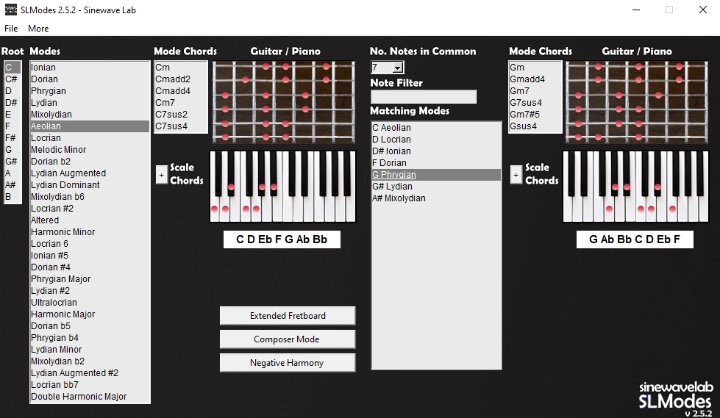
It helps you experiment with:
- Modal chords
- Guitar fretboard shapes
- Chord progressions
- Modal modulation
- Negative harmony ideas
If you play guitar and want to access 60+ music modes, SLModes is waiting for you
Join the Newsletter
Interested in music theory like this? Leave your email below and I’ll keep you updated.